Issue 6: Rewind
Issue 6 unspools our twisting, changing past, touching on themes of nostalgia, family cycles, ageing, health, childhood and memory.
We’re privileged to release these voices, both new and familiar, of writers in Aotearoa.
~~~
Featuring personal essays from Leilani Tamu, Sarah Dillon and Cian Dennan; poetry from Hebe Kearney, Sage Garrett, Giselle den Breems, Whaitiri Tua-Warbrick, Meg Hamilton, Holly Rowsell, Isabel 玥 Li, Niamh Hollis-Locke and Freya Turnbull; and a short story from M.D. Dela Paz.
Cover art by Layal Moore.
Cover design by Madeline McGovern.
Page art by Janie Shaw and Krysana Hanley.
Read the issue PDF [copy and paste into browser]: https://www.circularpublishing.co.nz/s/circular-issue-6_rewind.pdf

-
Kia ora koutou,
We welcome you into the past with circular’s sixth issue, Rewind. Moving through themes of nostalgia, family cycles, ageing, health, childhood and memory, Rewind unspools our twisting, changing memories.
We chose to open issue 6 with Hebe Kearney’s ‘handheld dystopia’, a piece about pop culture and music devices, looking at the past from the future, and carrying on. Sage Garrett’s ‘Dinso Road’ sees its narrator moving swiftly through a small part of the world and almost feeling overwhelmed by it. Similarly, Giselle den Breems captures a glowing, passionate sense of watching, but the pace is slower – it warms us into the wonders of time passing and time sitting still. From within the stillness of the MRI machine and its sounds, Leilani Tamu remembers some poignant and expansive moments in her life. Whaitiri Tua-Warbrick then stoically draws on a specific intergenerational ache, and it is at this point that we more sharply transition into the grief of personal loss, which we felt was important to include in Rewind, as it joins past and present into a continuous circularity. M.D. Dela Paz’s ‘In the Gullet’ explores this through a surprising take on folklore, and Meg Hamilton’s narrator undergoes EMDR therapy, seeking a light that ceases to be painful. Sarah Dillon’s essay quietly mourns certain geographical imprints and a long-dead elephant taken to Pōneke a century ago, before Holly Rowsell’s ‘motion sickness’ takes us down winding roads towards somewhere new, away from familiarity, and Isabel 玥 Li shows us a love fractured and altered by time. Cian Dennan’s essay then reminds us that music has the power to irrevocably and even spiritually link generations. We felt that this melded nicely into Niamh Hollis-Locke’s ‘Look, kid, no one gets out of this one alive (revolving doors, trapdoors)’, which ruminates on ageing and estrangement while acknowledging that some things stay the same. Nostalgia has the power to invoke strong, beautiful memories, but it risks becoming saccharine, especially if we glamourise the past simply because it has passed. Issue 6 is therefore about finding a balance between fond memory and melancholy, childhood and maturity, the “what was” of history and “what if” of the future. We could only conclude Rewind with the antithesis of nostalgia: Freya Turnbull’s ‘RANT BLOCK (AFTER MICHAEL MCCLURE)’.
Of course, we would also like to thank Layal Moore, Janie Shaw and Krysana Hanley for each of their artistic contributions – these pieces greatly enhance the textured look and feel of Rewind.
circular issue 6: Rewind features iPods, corner cafés, a bird in the hand, Kermit the Frog, the ever-burning sun, guitar-playing Jesus, EMDR therapy, undulating earth, winding roads, the real Real Groovy, Russian dolls and dirty dishes.
We also wanted to update you, our followers, the inner circle (🐍), on happenings in circular’s back office. Our three editors have all moved out of Wellington in the past year (hence the lack of live events in Wellington) and are operating long-distance, fueled by some strong coffees/cups of Dilmah extra strength, now wrangling timezones and calendars. We wanted to reassure everyone that we are still just as passionate about the circular ethos, and remain committed to publishing as a form of rebellion and necessity – art is a refuge, more than ever, in difficult times.
Thank you again for all your support! We hope you enjoy the issue.
Mauri ora,
Stephanie, Brooke and Madeline—circular editors
-
we’ll boot up your old iPod Touch / after the apocalypse / so we can play Doodle Jump while the world burns / i mean / hey / with everything lost / you’ve gotta get your wins somewhere /
we’ll be picking our way through shattered buildings / nuclear wasteland / blasting Avril Lavigne / a tame sort of punk / one wired earpiece each / a lack of Bluetooth compatibility /
the days will whittle away / trying to get the background radiation / charging that blue iPod Shuffle with no cable / i won in a beforetimes colouring competition / we’ll know it doesn’t work like that / but even survivors have to dream /
we won’t have the file on any other device / i’ll really want to hear / The Climb by Miley Cyrus / which is about 7 skips in / so the striving will be ceaseless /
my iPod Classic remains a stalwart / even after eschaton / thick as a brick / we use it / break them / a whole 160 GB / enough space to store / MP4s of Vanessa Hudgens music videos / we’ll even watch / Sneaker Night / we’ll hardly remember those / sneakers / there’s so much to forget /
when the air goes quiet / we’ll curl up by the campfire / look at Twilight stills i uploaded in 2010 / admire their cleanliness / then we’ll smother the fire / welcome darkness / we won’t attract unwanted attention /
PictoChat will still inexplicably work / on our old Nintendo DS Lites / we’ll sit side by side / sending drawings / of the latest mutants / unfortunately / the only gamecard we’ll have found / is The Sims Castaway / which is a little close to the fucking bone /
the iPod Nano / will entertain us / with Vortex / iQuiz / while we huddle / as unprecedented weather events / howl through the thin lines / of our precarious lives /
sometimes i’ll even text you / off my old Nokia / when you’re out hunting / but it won’t send / all the celltowers fell / in the cataclysm / you won’t have a phone / i’ll know this / but i’ll show you the text / when you return / we’ll pretend / we’re communicating long distance /
when i’m feeling lonely / i’ll just scroll lovingly through the album artworks / on one of the iPods / the satisfying clicks / one to another / the beautiful colours / i’ll miss seeing / so many faces /
eventually we’ll have to trek back to the generator / which will always be gruelling / but that’ll be why it’s survived / we’ll crouch to charge our old handhelds gleefully / grinning teeth lit up / by the Nokia’s hand-holding boot-up screen / we won’t know why / we chose these things / maybe they’re just better / maybe / sometimes all you need to keep you going / is the grim force of nostalgia /
—
Hebe Kearney is a queer, Pākehā poet from Ōtautahi who now calls Tāmaki Makaurau home. They run Blackout Poetry Aotearoa, through which they promote ‘found poetry’ by offering workshops, competitions, zines, exhibitions, and collaborations. They believe strongly in community, and the transformative power of poetry, even for people that don’t consider themselves ‘poets’. They have also always written ‘conventional’ poetry, enjoying using their own experiences alongside their BA (Hons) in History/Classics to fool around in the past for poetry’s sake. This poetry has been published in places like: bad apple, circular, Mayhem, Mote, Overcom, Poetry Aotearoa Yearbooks, Starling, Sweet Mammalian, Symposia, takahē, Tarot, The Spinoff, and Turbine. They also perform their poetry at events, including such fabulous endeavours as: bad apple, Poetry Live, SameSame But Different, Starling, Verb, Yellow Lamp, and Zinefest. You can follow their antics on Instagram @he__be, and @blackoutpoetryaotearoa.
-
It was still too early to feel anything and
we were walking through markets and
party streets and cafés and they said I was
thinking too much, but I was thinking of you.
A van drove past us, speakers blaring,
letting everyone know about the fights going on,
about young men putting on rhinestones
to go at each other like cats.
I went to buy some rice, but the lights were too bright
and there were too many people and it was starting
to kick in and there was a girl at home
who just might love me.
I didn’t know anything of this world
on the day we followed the sun, but
here it was crashing over me like waves and I couldn’t speak.
Not to the woman selling smoothies, not to the man
who needed a light, not to my family until morning.
We’d been walking around this roundabout
for hours, and we were hoping to figure it out
the next time, I still don’t know anything —
not this world or the one before or the next, but I might know you.—
Sage Garrett (he/him) is a writer and artist studying religion and political science in Pōneke. Outside of writing, Sage can usually be found cataloguing Frankenstein adaptations or interrogating friends about their complicated memories of Sunday school. sage__garrett (instagram)
-
[To read this poem in its intended formatting, please consider viewing our issue 6 PDF]
Morning mist clearing into dusty blue skies, you by my side.
The cool glass of large windows to press your forehead against,
the deck dark with dew dark blue. Our bodies warm
save for when we’ve just come in from the sea. At last
I am used to it it comes naturally,
like they all said it would.Come dark, that rich, warm, midnight
blue framed by our fresh sheets and breathing bodies the lamplight-souls
strewn across the dunes the lines of the past faded from red to purple to white.
The skin heals at the pace of the tide.
The ghosts sing and murmur. The clothes dry
on the line overnight.When it is still enough, the damp sand reflects the stars.
The moon plugs the basin of the tipping sky the lullaby of it all
when I take your hand. We are still young it hasn’t taken
decades to arrive.I cup the moments in my hands, like water, like air, like a bird.
I carry them back to the house, arriving empty-handed,
soul-stranded, a pane of glass between me and the glowing room.Sat cross-legged on the damp wood, I watch the girls play
from the other side. The light is reflected on my face,
my face reflected on the window. Inside, the silver strings tremble
with their movement: harp from above marionette from below,
flesh from within. I turn to see you standing there, a living bird in your palm.—
Giselle grew up in Auckland and began writing poems at age six, a year that saw highlights in ‘The Cloud Bird’ and ‘Spring Rain’. Now she lives in Wellington, studying psychology, philosophy, and French, and writing much sadder poems. Some of these can be found in Starling and Symposia.
-
On the morning of my MRI, I don’t tell anyone where I’m going. As I walk out the door, I call out I love you to my kids, and then take the next steps, alone.
The first thing I notice are the crystal shards of frost on the grass; summer has dimmed her light. It’s the first day of the Lunar New Year: the Year of the Horse. Time feels like it’s speeding up, just as my ability to grasp it is slowing.
I walk up the concourse platform to wait for my train. It’s a couple of minutes away. Glancing around, I appreciate the way the morning light is dancing on the horizon, casting shadows on the maunga in the distance. Tāmaki Makaurau is such a beautiful city; green and lush with volcanic ridges and the glistening ocean never far from sight.
As the train arrives, I take a moment to look once more at Ōwairaka in the distance. I don’t want to forget the arc of her protective embrace. She’s always watched over me, and I’ll miss her when I leave this whenua.
*
Arriving in Newmarket, I make my way along Nuffield Street to a cafe called The Reaper that serves “coffee to wake the dead”. I walk up to order and talk to the barista. Her rizz has all the ‘don’t give a fuck’ qualities I haven’t quite been able to master, despite being at the nexus of midlife. Perhaps I just missed the train, I think, as I distract myself by checking Instagram.
My sister has shared a reel of Kermit the Frog singing “The Rainbow Connection”. It brings back all my Sesame Street memories of the warm, fuzzy-hearted love I had for that little green puppet, as a kid. Peering at him, forty years later, through the phone that is now my constant companion, my heart feels a little lighter. Bobbing my head side-to-side, I smile as Kermit strums his banjo and belts out the question “who said that every wish would be heard and answered when wished on the morning star?” Yes Kermit, I think, who said that? Why am I still stargazing?
After slurping back my coffee, I walk up Remuera Road. Wandering up the hill, I notice the weeds, mosses, and grasses poking up through cracks in the concrete. It brings me delight; not only seeing nature rebel against urbanisation, but also to recognise the privilege of being in an able body that has the ability to witness it. It reminds me of the guided walks my nana and I used to take. Walking on her own was a struggle during her latter years. Glaucoma robbed her of her eyesight and she gradually became housebound. During our 20s and 30s, my sister and I would take turns walking Nana up and down our street every day. I remember her gentle but firm grip on my left shoulder, and how honoured I felt supporting her in this way. Walking with Nana was its own form of rebellion; albeit against the permanence of blindness.
*
As soon as I step into the polished stainless steel lifts of Auckland Radiology, I’m aware that I’m in a very different environment. A controlled one. I don’t feel resentful about this, but I do notice that the anxiety I’ve done well to manage up until this point has gone up a notch.
Walking up to the counter, the guy at the reception takes my details and hands me two forms. He has a piercing, a hedgehog-style mullet and an Irish accent. When he hands me the clipboard, I notice he does so with the clip at the bottom, so the forms are upside down. I notice the cheeky sparkle in his eye and I decide it’s his own way of adding a little flourish to the otherwise sterile space. I give him an appreciative smile and then take a seat on a fancy red couch.
I work my way through the forms and confidently circle ‘No’ when it asks whether I could be pregnant. Answering the question brings back a recent memory:
I’m at a Niuean Church Sunday School picnic. One of the Aunties, who is in her late 70s, asks me if I’m going to have any more kids. I look at her, thinking she is joking; she mustn’t know how old I am…
Me: “Oh no, definitely not. I’m 43. I’m too old.”
Aunty: “You’re not too old! You’re still young. You’ve got plenty of time to get naked and dance!”
Back at the radiology reception, I smile as I recall the cheeky look in the old lady’s eyes and her wonderful toothless grin. Get naked and dance! Well that bit sounds alright, I think to myself. It’s all a matter of perspective.
A moment later, the radiologist comes out to meet me. She reminds me of the barista at the cafe, with tattoos and heaps of jewellery. On one forearm, she is wearing chunky silver Pandora-style bracelets, and on the other, woven cotton-and-leather friendship-style ones. Her name badge reads Anchara. I discreetly look it up on my phone as she flicks through my forms. It means “strength, calmness and growth”.
She smiles and asks if she has said my name correctly. This means a lot as I’m used to professionals butchering it. I nod my head and follow her into the changing-room area.
She talks me through a special consent. It’s related to a contrast that they may need to inject into my system. She says it’s called Gadolinium and is a liquid metal that will pass through my kidneys after about 24 hours. She says it’s relatively safe, but there is a small risk of side effects.
I imagine metal coursing through my bloodstream and wonder about how this might affect my agaga, my spirit. I know that if I were younger and still planned to have children, I would say no, but now, knowing my body won’t carry babies again, the decision requires a different kind of thought process. How might this affect my spiritual body?
In a reassuring voice, Anchara, the radiologist, says, “We’ll only inject it if it’s absolutely necessary.”
Looking at her again, before making my decision, I notice that she’s wearing a small red cotton necklace. Knotted onto the thin thread are three small pebbles. E Toru Ngā Mea. The waiata flows through my mind and I know I’ll be okay: my ancestors will make sure of it.
*
After changing into my gown, I wait for a few moments, clutching my basket of belongings. Anchara has gone into the locked-off area, and I’m surprised when another woman comes out to collect me. She butchers my name, saying “Lie-Lani”.
Following her into the room, I’m relieved when I see Anchara again. The two radiologists guide me to the MRI. They say that once I lie down, they will be placing a large helmet over my head. They will also put earplugs in and I will need to be prepared for an “expanding” sound when they’re inserted.
The first thing I notice when I lie down is an image of a cherry blossom tree set against a blue sky projected onto the roof. Of course, I think to myself, as they adjust my head and put cushions on either side; nature is a gift, even in spaces like this.
*
Closing my eyes, I let my conscious mind settle into the rhythm of my breath. I reach for entrance to the contemplative room nestled within my subconscious. Over the years, I have learned how to access this sacred space in times of need, and it has only been when I haven’t been able to grasp the thread of my breath (i.e., during panic attacks) that I have struggled to find the entrance. Once through the door, though, I know I’m safe.
Entering that meditative space, the first thing I observe is surprise at the particularity of the sound the MRI is making. It is akin to the sound of an ‘ao wielded by a Tufuga.
Tap Tap Tap
Tap Tap Tap
Tap Tap Tap
pause
Tap Tap Tap
Tap Tap Tap
Tap Tap Tap
pause
An ‘ao, used in Samoan tātau, has been in use for over 2000 years. Made from either bone or metal, it is a comb-shaped instrument that has fine sharp teeth, traditionally fastened to a shell, and attached to a wooden handle. The Tufuga tā Tatau then uses a sausau, a wooden mallet, to strike the ‘ao, driving the teeth into the skin; pausing rhythmically as they dip it into a pigment made from the soot of burnt candlenut. When I was 21, the ‘ao bit me, as Tufuga Petelu Suluape brought to life the taulima that dances on the flesh of my right arm.
buzzzzzzzzzzzzzzzzzzzzzz
buzzzzzzzzzzzzzzzzzzzzzzzzzzzz
buzzzzzzzzzzzzzzzzzzzzzzzzzzzzzz
buzzzzzzzzzzzzzzzz
A sudden shift in tempo. The MRI is making a buzzing, determined, sound that reminds me of a drill and a hammer.
My mind wanders and finds its way to the New Zealand High Commission in Nuku‘alofa, Tonga. It is September, 2010. The High Commission is being renovated, and it has been decided that we must continue to work inside the building, despite the noise. Trying to concentrate and maintain my focus in my new job (I’ve only been there two months) is a trial, not helped by the fact that every two hours I have to lock myself away in a private room to express milk for my three-month-old baby.
buzzzzzzzzzzzzzzzzzzzzzz
buzzzzzzzzzzzzzzzzzzzzzzzzzzzz
buzzzzzzzzzzzzzzzzzzzzzzzzzzzzzz
buzzzzzzzzzzzzzzzz
I struggled, gritting my teeth to get through each working day. The High Commissioner was mildly annoyed with it, but was usually out attending meetings. For the most part, it was those of us stuck in the office who had to dig deep to cope, and sometimes I would go for walks to escape.
And there it is, the stark image of its captivating form: the Waharoa. I found this taonga lying on the floor, without a soft cover, gathering dust, in a room that would later become the entrance to the High Commission. When I discovered the richly carved ancestral gateway in that state, I knew tapu had been breached. I knew this, not because I whakapapa Māori but because of what I felt – a crawling sensation. Somehow in the midst of the renovations, this sacred taonga had been casually left in amongst construction chaos without due care.
I took action, sent messages to the friends in my networks who would know what to do and received instructions. It was, as I suspected, not okay that the Waharoa had been removed and stored without following tikanga.
Waharoa play a role in the transition from the secular world into sacred space; the presence of these taonga within Western institutions does not diminish the tapu inherent in their mauri, lifeforce. Sometimes, when I sleep, my spirit finds its way back through that sacred portal.
Beep
Beep
Ding Ding
Beeeeeeeepppp DingDingDingDing Beeeeeeepppp
Ding Ding
Beeeeeeeepppp DingDingDingDing Beeeeeeepppp
Beep
Beep
Dial-up internet. I’m thrown back to the 1990s and the anticipation of waiting to connect.
Our family had one PC. Next to it, we had a small TV with a SEGA Master System. We all used the family computer, for homework, to check emails and to browse the internet. The sound of dial-up symbolised magic and discovery. So it was a bit of a shock when I stumbled across pornography in the search history. I remember telling my sister and trying to figure out what we should do. I must have been about sixteen. We suspected who had been looking up porn; the question was, did Mum know?
As it turned out, she did, and she wasn’t bothered. From memory, she said something like, “It’s just porn, it’s fine, it’s not a big deal.” Looking back now, I guess in a way I can see where she was coming from. It wasn’t like it was bestial or child pornography, but even back then, something didn’t sit right, it still doesn’t.
I mean, it was the family computer.
biizzzzzzzzzzzzzzzzzzzzzzzzzzzzzzzzssshhhhhhhhhhhhhhhhhhhhhhhhbizzzzzzzzzzzzzzzzzz
Shhhhhhhhhhhhhhhhhhhhhhhbiizzzzzzzzzzzzzzzzzzzzzzshhhhhhhhhhhhhhhhhhhhhhbizzzzzz
Argh, that sounds like the annoying grey, white and black fuzzy screen that used to come on when we had to tune the TV during the ‘80s. It was horrible. We used to put our fingers in our ears and wince as the adults tried to find the right channel.
When we got TV3 in ‘89, it was so exciting! For us kids, TV1 was boring; it was where dry old Coronation Street lived, along with the 6pm news. TV2 was where all the fun programmes could be found, especially the after-school cartoons like He-Man and the Masters of the Universe, Jem and the Holograms, ThunderCats, Transformers, and Inspector Gadget. If we were lucky, and the adults let us, we’d occasionally get to watch Kylie Minogue and Jason Donovan on Neighbours. When TV3 came along, we suddenly had a choice between two ‘fun’ channels.
And of course, there was the ‘Goodnight Kiwi’, the sweet little bird, who told us all when it was time to close our eyes, snuggle up, and drift off to sleep.
And then, finally, stillness, quiet.
Inside the MRI machine, I wait for a moment, then two, then three. There’s no sound. I slowly open my eyes and, for the first time, notice that the peepholes in the helmet are square. Inside each of them is a small rectangular mirror that’s slightly angled. It reminds me of the View-Masters we used to play with as kids. I treasured my little red one, and loved peering into the multifaceted worlds revealed through the filmic windows of cardboard reels.
Slowly, my body begins to move, and in a few seconds, I’m welcomed back by a blue projected sky sprinkled with a flush of pink cherry blossoms.
*
Stumbling back into the world after I exit Auckland Radiology, the first thing I notice is a tattoo. It’s on the back of a man’s calf and features a large pīwakawaka, fantail, with distinctive Tongan ngatu motifs in the middle. I remember that pīwakawaka often bring news of death or act as guardians. I hope for the latter.
I make my way to Newmarket train station and miss the Western line by just a few moments.
Sitting alone, I stare at the wire fence of the car park on the other side of the tracks and listen to the cicadas. Looking down, I notice a prism of light falling gently on my lap, a refracted rainbow. Opening up my phone, I search for Kermit’s song and sing along as a silent tear kisses the arch of my cheek. I touch it with the tips of my fingers and whisper: yes, someday we will find it, the lovers, the dreamers – and me.
—
Leilani Tamu (aka Lani Grace) is a poet, former diplomat and creative nonfiction writer from Tāmaki Makaurau. She is the author of two poetry collections, The Art of Excavation (Anahera Press, 2014) and Cultural Diplomacy (2017). She has been published in a range of journals and anthologies, including Landfall, takahē, Griffith Review, Hawaii Review, and JAAM. She has reviewed books for Radio NZ and Kete, written a column for Metro Magazine, and served as a judge for the 2022 Ockham New Zealand Book Awards. In 2013 she was awarded the Fulbright-Creative NZ Pacific Writer’s Residency and in 2025 received a Creative NZ writing fellowship. She is currently writing a collection of personal, braided essays, anchored in memoir, and is also working on her first play. Her writing engages with themes of ancestry, memory, and rebirth. She is drawn to stories that examine the tensions between love, belonging, and suffering.
-
Take it easy e hoa.
That ain’t an ask; you know that.
You’re wearing us out without
our pōtae about our
bald ice head. What, you
think cancer grows on trees?
Nah bro; grows on us.
Remember the last time
you pulled this shit? Remember the gang
we sent up to your lovely porch, armed and a-knocking?
The leader taught us a few things more,
before he lay at Hine’s side at last.
How to touch the dark night’s waist.
How to pierce the side of our parents.
We’re good at bringing back
the long atom light
to the meadows, the fire
to the fields. Slow your boy
racer heart e hoa. Let us not
streak the world with
shadow anymore.
—
Whaitiri Tua-Warbrick (Rāngitane / Ngāti Raukawa) is a poet who lives in Palmerston North and is a multi-modal, omnipresent librarian. He writes poetry when he’s not out walking and trying to be a person. You can find his work in Landfall, Starling, bloodbath journal, Best New Zealand Poems and @maoribytheriver.
-
Lola Mini is dying. She’s been dying for as long as I can remember, but now she’s dying like she means it. She lies in bed all day with the television on for company. She only turns it off to pray the rosary, meditating on a different mystery every day. Joyful Mysteries on Mondays and Saturdays. Sorrowful Mysteries on Tuesday and Friday. Glorious on Wednesday and Sunday. Luminous on Thursday. ‘Into your hands I commit my spirit, O Lord,’ she prays, loud enough for me to hear. She rings a bell when it’s time for me to take out her arinola. I pour old-woman waste into the toilet and flush. She says I should be grateful I don’t need to wipe her ass. She says, ‘You should be grateful, Magdalena, that I’m too proud to make you do that.’ I say, ‘I’m grateful, Lola.’ She looks at me with cataract-cold eyes. The skin is papery white and bruisey around them. It hurts to look at her. I rub her feet. I feed her chicken arroz caldo without salt or spices or patis. When she opens her mouth I see the black chick’s beak in her gullet. It opens its mouth too. It eats the arroz caldo before it gets to Lola Mini’s stomach. It peeps and peeps and peeps.
*
When I was five years old Lola Mini’s friend told me about the Aswang.
Lola was playing mah-jong with her kumadres. They were sitting around a green table wearing black and looking glamorous with cigarettes hanging off their red lips, rollers in their hair. The way they were cackle-laughing and talking with loud-loud voices, you would have thought it was a party and not my mother’s wake. The mah-jong tiles went click, click, click against their long red fingernails.
I asked them why it was that everybody had to stay awake at a wake, and Lola’s friend peered down at me over the top of her half-moon glasses and said, ‘It’s because of the Aswang.’
‘The Aswang,’ she said, ‘might come and switch out your mother’s body for the trunk of a banana tree.’
‘Why?’ I wanted to know.
‘Because the Aswang likes to eat dead bodies.’
‘Why?’
‘Ay hala, stop saying why-why-why or the Aswang will eat you too.’Later in her bedroom that smelled like amber perfume and baby powder and candle wax, Lola Mini brushed my curly hair one hundred times. Tried to make it straight with the big flat brush with teeth that made my scalp itchy and sore. ‘Kahibalo ka, Magdalena, the Aswang will not really eat you for asking questions. Don’t believe that gaga.’
‘Will the Aswang eat my mama?’
‘Ay, no, of course not. The Aswang only eats bad people. So if you’re good, and you say your prayers, the Aswang will leave you alone. She might even make you her friend.’*
I hear the black chick crying through the wall at night. Lola Mini cries with it. She groans and begs God and me and anyone else that might be listening to please let her die.
*
The only man in Lola Mini’s life is Jesus. There are pictures of him all over her walls, looking beautiful and benevolent in all-white. In some of them he is laughing or playing the guitar. When my first period came and Lola slapped me on the cheeks with my bloodstained underwear, I stared over her shoulder at guitar-playing Jesus, trying to imagine the kinds of songs he played. If he played religious songs or if he was more of a Karen Carpenter kind of guy.
Why do birds suddenly appear?
‘Now that you’re a woman the men will come sniffing around you like wild boars. If you’re scared of the Aswang, you should see what men do. Men marry you then make you crazy then beat you up and then eat you alive. Never trust a man. A man is worse than an Aswang.’
Lola taught me how to hold my underwear under cold running water to get the stain out. She held it under the faucet, letting the water flow pink and cloudy into a bucket so she could water the vegetables with it. Waste not, want not.
She said, ‘Your Lola-Lola was an Aswang. And your Lola-Lola-Lola,’ and so on, like the begat-begats of the Bible on her nightstand. I sat there and she combed my hair while I counted under my breath. Eighty-one, eighty-two, eighty-three, eighty-four.
Lola Mini put coconut oil in my hair, so the nits slid right off. She cracked lice under her nails, wiped her nails clean on a white cloth that used to be my lampin. She showed me their bodies, bloated and black with my blood.
I tried to keep her talking, tried to keep her telling me these stories so I wouldn’t have to think about how my scalp hurt and how all that pushing and pulling made my head feel like it was going to pop off and fly away.
I asked Lola Mini how you make an Aswang. She said, ‘An Aswang makes herself. She eats the balut in her mother’s belly so that her mother can stop being an Aswang and go to sleep.’
‘But what if no one is there to eat it?’
‘Na hala, then she will get old and ugly and angry, and she will be an Aswang forever and ever amen.’
When the moon was full, takdol, Lola walked around with her hair wild and unbrushed, with big red buggy eyes that looked hungry for something. I knew to keep out of her way when she banged around in the kitchen, slicing up livers and gizzards to fry in deep bubbling fat. She put them into the kalan one by one with a slotted spoon. I pretended not to see her eat the livers and gizzards raw: one for the kalan, one for her.
At night I hid under my sheets and pretended not to hear her on the roof, stomping her feet and flapping her wings that went tik-tik-tik and made the air go still. I stared at guitar-playing Jesus and imagined him singing me a song.*
Lola Mini is dying. Her room smells like ammonia and acetone. Guitar-playing Jesus is smiling at her on the wall across her bed. I try to feed her rice and chicken livers and she won’t open her mouth except to say, ‘I’m so tired, Diwata.’ Calling me my mother’s name.
‘I know, Lola.’
‘I just want to sleep and sleep and sleep.’
‘Do you want me to turn off the TV?’
‘No, it’s too quiet.’
‘How can you sleep with the TV on?’
She shakes her head. She says, ‘I’m hungry.’
I say, ‘Open your mouth, Lola.’
She opens her mouth. There is the little black chick, black as the night, black as space, black as hunger. Peeping and peeping and peeping.
I put the plate of rice and livers on the floor. I sit on the edge of the bed where she used to brush my hair.
Lola leans against the headboard. She lets out this big, deep sigh, goes aaahh, and the black chick starts wiggling out of her mouth. It wiggles and wiggles until it pops out of her gullet and onto her lap. It shakes its wet feathers and looks up at me with buggy eyes. Beady eyes. Black eyes I can see my reflection in, upside-down.
I look at Lola. She is looking past me, at guitar-playing Jesus.
I scoop the black chick up in my fingers and I say, ‘Okay na, Lola. Sige na.’
I put the chick in my mouth. It wiggles on my tongue, flapping its wings, going tik-tik-tik. By the time it has finished its dance down my throat, Lola Mini is gone, floating up to Jesus who is singing her a song. It’s Thursday. She is luminous.—
M.D. Dela Paz is a Filipino writer who currently resides in Pōneke, Aotearoa. They have previously published and performed poetry under the pen name Saba D. Ha. Find more of their work at https://sabaisloud.wordpress.com/
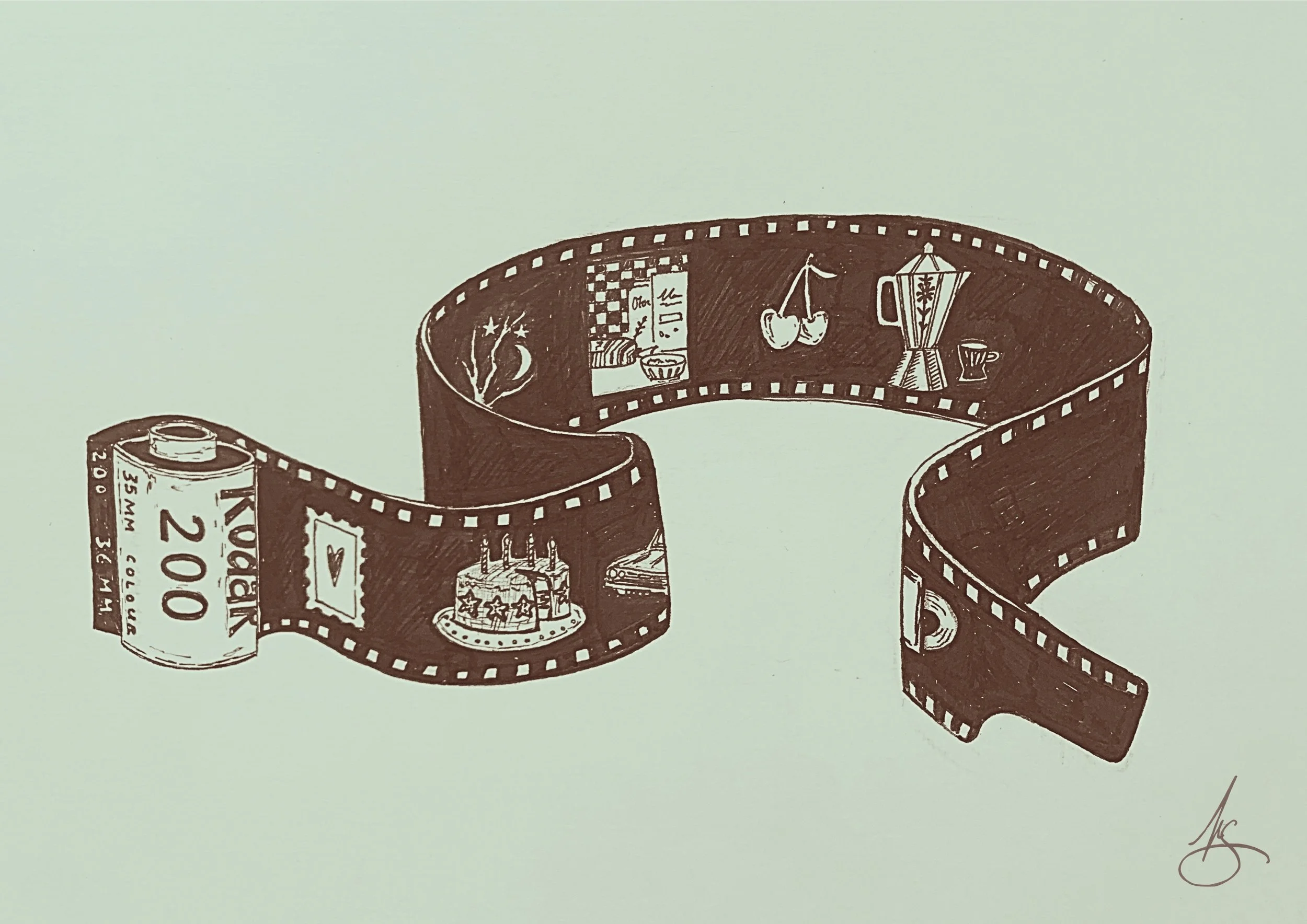
Artwork ~ Janie Shaw
-
[To read this poem in its intended formatting, please consider viewing our issue 6 PDF]
Sometimes the sky
gets busy with sounds.
The crops won’t grow and my body aches.
Feeling is a tongue worked over the mind.
I am out in the field with my arms
raised. I sweat in syllables, likeWhen? Where? How?
She moves her fingers back and forth.
She is a shadow murmuring
around the sun of my pupils.Follow the thread of my fingers, she says.
She holds the knot, snips the cord,
shakes the memories loose.She asks, What are you sitting with now?
A landscape seared in solar eclipse,
vision burning with black spots.
The earth, turned over, tilled until charred.
Memory, the tool brought down again and again.I labour the field. I harrow the field.
I am the body, the mind the un-seeing eye.
I am nothing but my heart’s beat on a string
The past, a frayed end.She says, let the body feel. Let it be culled.
But the sky is so loud, I shiver. I curl into myself,
like a weakened pulse-point.
I sweat in syllables,like, why why why?
I sweat into every new dawn,
around every flash of remembrance.
Every sunflare setting my nerves sizzling.
She places the stone in my lap,
asks me to stay.I don’t know it yet, but she does.
She’s seen it, the first green shoot
searching for light.—
Meg Hamilton is queer writer living in Ōtepoti Dunedin with their partner and two cats. Their work has been featured in bloodbath journal, Lucire, and on Newsroom.
-
She told me on the way home from a wedding. Lesley had been a local tour guide, and leftover facts still sprang out when you least expected it.
“Did you know there’s an elephant buried under that park?”
I looked out the car window toward Appleton Park, and all I saw was the steeped tea of the night.
In the 1840s, Appleton Park was, of course, bush. The hills shouldered a valley, through which the Kaiwharawhara Stream ran busily on its way to north-western Te Whanganui-a-Tara and what would come to be known as Otari-Wilton’s Bush, before tracking east to Kaiwharawhara and spilling into the harbour.
The stream watched on as Karori was settled: a small suburb that was hard to reach from the larger Wellington settlement. It wasn’t until the 1880s that the section of the stream around the now-Karori entrance was culverted, the gully filled in, and until Chaytor Street was constructed, welcoming visitors from Northland, Wilton, and the city centre alike to the suburb’s green hills.
Land is really only a series of footprints, extending downward into the earth with the passage of time. My footprints might layer on yours, yours on someone else’s, and so on, down to the footprints of tangata whenua. When we investigate the history of our land, we trace histories, memories, of our own.
The elephant, it’s said, never forgets. So what better a genesis for historical inquiry? The grass-crusted mud of Newtown in Wellington was a long stretch from the Nellikuth forest reserve in Nilgiris, a mountain chain in Southern India. Surely the elephant must have thought so, too. Captured in 1926 and tamed by mahout Sheik Arju Hia for just a few weeks, Nellikutha—Nellie—became part of a much bigger tale, shipped to Aotearoa as part of a gift from the Madras Government.
Nellie did not come quietly. Originally captured in an elephant drive—whether a Moby Dick-esque tussle or a cattle muster, it’s a scene the books have largely left to our imaginations. The elephant bore scars from a concerted objection to rail travel, but seems to have settled once she reached the coast, and after the long trip from Calcutta to Wellington, the Evening Post described her, on arrival, as “six years of age, quiet almost to silence, and quite willing to be petted and punched by any one” (1927).
Nellie refused, though, to be lorried to the Zoo. She was walked by the Sheik on 15 January 1927 for around five kilometres, from the wharf where the Sussex berthed to Newtown. The Newtown of today is cobbled with pedestrian footprints. Convenience stores and second-hand books, dollar shops and cafes, with all the hustle of the hospital and the endless rhythm of the Adelaide Road traffic lights guiding the suburb’s heartbeat. People of all generations, many cultures, walk the concrete. Remember, though, that—just that once—the soil bore the lumbering tread of an elephant.
Do you remember the footprint scene in The Lion King? I do, because it was the first film I ever saw after getting prescription glasses. Four years old, my myopic self bounced with my mother around the corner from the optometrist to the cinema, and must have frustrated any number of devoted moviegoers with a loudly whispered refrain: “Mum! I can see!”
The scene comes just after the naughty cubs have been rescued from their adventure to the Elephant Graveyard by brave Mufasa. Nala is returned home to her mother while Simba—no more than a pair of glowing eyes in the Disney dusk—has been summoned by his father, who sits a way ahead in the grass. As Simba follows, slinking to his father’s side, he steps into a divot in the mud. We see from his point of view: his own tiny paw, dwarfed inside the deep pawprint of his father.
A film scholar will give you any number of reasons for the scene, but one might be to convey the imprint of each being on the earth, light or heavy, and the way our own footprints press into those left by the generation before.
As Nellikutha was settling, stride by stride, into the rhythms of everyday elephant rides for delighted children, the tussle over whether her mahout should remain with her simmered indefinitely, and the suburban politics of Karori bubbled over. In 1929, it was proposed that the culverted site of the stream alongside Chaytor Street should be used as landfill (Burch, 2001). With the Hutcheson Road tip at capacity, the growing city needed another site for rubbish deposit.
The site was finally converted in 1934–35 using a technique called the Bradford Tip System, a kind of terraced layering interspersed with soil from the sloping gully sides, which generates significant amounts of heat—up to 130°C. Rats cannot survive: an oddly prescient precursor to the rodent massacre that would occur a hundred years later at the Zealandia Ecosanctuary across the road.
The Chaytor Street tip was not really large enough for the needs of the growing city, but couldn’t be replaced with a larger capacity site for some years, as the nation tumbled into the Second World War and all its infrastructural effects. Tipping was complete at Chaytor St. by 1935, but the visual impact remained, with shifting earth and the occasional steam rising from the decaying vegetable matter far below the topsoil.
My ex didn’t agree, but I’m certain the land on the tip site still moves significantly. He maintained there are two rises in the park consistently: an initial smaller rise from the north end and another, bigger one as you almost reach the south. I am sure, though, that the hill—or hills, mounds, really—are never in the same places. This says everything about the ways in which we each perceive the world
After breaking the Zoo record for attendance on her first day in 1927, Nellikutha became something of a sensation: not only in Te Whanganui-a-Tara itself, but throughout the North Island. She amassed a number of tricks, grew by a reported eight inches in height and a ton in weight, and by all accounts developed a playful personality.
The other day I took my small brother to the Zoo. We saw the elephant, Nellikutha, having her bath. Really, Fairie, it was as good as any comedy at a theatre to watch her try to evade the good-humoured keeper, who was trying his hardest to scrub her down with a broom. She squirted water at him with her trunk, splashed him with her legs, and, oh, lots of other things! — “MAM’SELLE JOIE (14)” (Letter to Faerie Ring, Evening Post, 1942).
By the end of her first year at Wellington Zoo, Nellie had given rides to over five thousand children, eight at a time, on a specially made saddle box. Her fame spread further than just Te Whanganui-a-Tara. In 1934 the Whanganui Chronicle, Taranaki Daily News, Waikato Times and Manawatū Times syndicated a spread of photographs of the elephant performing for delighted crowds.
Each weekday morning, the number two bus takes me from the far end of the now-sprawling Karori suburb into the city: toward the Zoo, in fact. I press my face against the cold glass as it trundles around Chaytor Street. In winter the blades of grass stand crisply to attention, loaded with dew or even frost. In summer they stay verdant green and, if not mown recently enough, they ripple with the wind. Some days they cover a noticeable slope to the south; some days the field looks almost flat, almost fit for sport or running. The land is still breathing, still reshaping itself around each piece of trash or treasure, each human or vehicle track.
It was in Karori that I became a walker. Not near Chaytor Street, but around Karori South—sometimes just circumnavigating the park’s kilometre loop, but more often venturing up to the Skyline track. It will never not be a surprise to me that after the initial struggle up a zig-zag of gravel, you emerge from deep suburbia into the hills proper, crossing farmland with panoramic views of Pōneke’s coasts. Weekend after weekend I learned the trails, my feet growing more sure and my mood able to size exactly the track I needed for the day. I left memories behind there; I collected others. Maybe that’s what it means to live somewhere.
At the beginning of Nellikutha’s tenure, the papers optimistically declared that she was expected to keep growing for another 32 years. It wasn’t to be. On 8 August 1944, the Evening Post carried the headline: ‘The Elephant is Sick.’
Nellikutha, the children’s favourite at the Newtown Zoo, is very sick indeed and there are fears that she will not survive. Whether she picked up something harmful about the grounds or whether some poisonous or near poisonous substance found a way to her fodder is not known. She cannot stand and is under constant care by the curator, Mr. J. Cutler, and the Zoo staff acting under the advice of a veterinary surgeon.
Seven days later, the elephant died. Variously reported as an infection, intestinal trouble, or ulcers, tribute was paid to both the elephant’s impact on the zoo and the staff’s dedicated care. There was even an obituary in song, entitled ‘Farewell Nellikutha,’ published (Evening Post, 1944).
No matter how heartfelt the public response, the death of an elephant is ultimately a practical matter. Around 5,000 kilograms of flesh and bone need to be disposed of. No records remain that state exactly where Nellikutha was buried, but it is documented that a heavy transporter took her to “one of the city tips” (Evening Post, 1944). The city tip operational in 1944 was, of course, the Chaytor Street tip.
French philosopher Pierre Nora popularised the term lieux de mémoire to speak about places or sites of memorial (Nora, 1989). Nora followed the vein of Martin Lefebvre in situating the term within socio-cultural studies, as a social production of space. A lieu de mémoire, in this sense, can be a cenotaph; a place where a community gathers to commemorate loss; a site marked with echoes of colonial oppression such as Parihaka or, more recently, Ihumātao.
What, though, if the sites themselves remember? What if the lieu de mémoire is not predicated on any human act of remembrance, but is embedded in the land?
After the completion of tipping at the Chaytor St site, and concurrent with an emphasis on community activity post-WWII, an area for recreation was proposed. Quite in the opposite vein to the way that locals had dumped refuse at the site for years, the land was now hotly contested by various groups and societies all keen for ownership, or at least partial use, of the dump site. The eventual outcome, under the City Council’s remit, was Appleton Park. While bits and pieces of play equipment and signage were installed and removed over the years, the park was established in its current form in 1992, and following the final touches (stripping, infilling, grading the land) it was declared complete in 1994.
In and around 2022, Appleton Park was a lonely place in many ways. Only the most determined pedestrians cut the corner by traversing the open field, because the bus stops lie at both the north and south ends. Over four years of passing the park twice daily, the sole occupants I observed were a pair of Paradise ducks who fossicked for grubs in the middle of the park. They were sometimes at Appleton, sometimes at the other end of the suburb at Karori Park or one of the schools. It makes sense: ducks are scavengers, treasure hunters. The frail, hollow-boned native birds seek their nectar in the nearby sanctuary.
At the park’s south end is a busy car park, designated Zealandia’s ‘overflow car park’. When the car parks next to the sanctuary’s main centre and down the adjacent road are full, visitors can park at the head of Appleton Park and walk 500 metres or so to visit the popular attraction—watching the kākā feed or spotting some of Aotearoa’s least frequently seen native bird species. There are often a dozen or so vehicles in the overflow park, and it feels odd but also fitting that, once again, Appleton Park is dedicated to the spare, the leftover, the items we aren’t quite sure what to do with.
The park’s eastern perimeter, along Chaytor St, is lined with twenty-six mature pōhutukawa trees. Some are spindlier, with street lights lacing through their branches; others are old and heavily bearded. Pōhutukawa, whilst iconic, was an odd choice. They prefer the coast, thriving on salty air and warmer climes, and are notorious for clinging onto cliffs and promontories, almost as if the more difficult the site, the more determined the tree is to thrive. It is a typical colonial pursuit to tame them into submission and stick them in a designated park to stand silently.
The tennis court on the park’s north side is also quiet. One would think this kind of recreation asset—situated in one of Aotearoa’s most populated suburbs—would see regular use. But the concrete court is usually quiet and cold-looking; it huddles sullenly into the side of the steep bush-clad west face of the park. I have only seen people playing there a handful of times.
2024 and Karori simmers again. Cycle paths are the most recent catalyst, and public opinion putters and spurts. Regardless, the paths are going in. One morning a string of cones is laid across Appleton Park, and over the passing weeks it becomes apparent that a cycle and walking path will cut across the field—following the gentle curve of Chaytor Street, but cutting a swathe of bitumen through the soft grass and keeping cyclists out of the melee of buses and cars. The path also leads walkers across a slightly shorter route than the footpath, following what urban planners would call ‘desire lines’, or sometimes, ‘elephant paths’.
An expert from the University of Michigan, hell-bent on examination, once tried to excavate an elephant that had been buried in a landfill. Toledo Zoo called in the experts; they had been asked to remove the elephant remains from the tip because space was getting tight. It was soon evident why. Although the elephant corpse had been in the landfill for seventeen years, instead of a pile of bones, the scientists uncovered a largely intact corpse. The thousands of kilograms of flesh, bone, sinew, buried for almost two decades, still hadn’t decomposed.
I’m not sure if this has anything to do with the maxim ‘an elephant never forgets’, but it seems likely. In any case, even if the elephant might forget, the land remembers. I pass Appleton Park on a bright winter afternoon and peer out the bus window. Nobody is adding their footprints to the layers of the land today. There is just one mound clearly visible in the undulating park, but it is larger than usual. As the bus trundles past, I swear the highest section of the grassy turf gently, carefully, shifts downward slightly: almost like an elephant exhaling a savasana breath.
Works Cited
Burch, Judith. “Appleton Park -- A load of rubbish.” Stockade, no. 34, 2001, pp. 4–12.
“By The Sussex.” (1927, January 15). Evening Post. https://paperspast.natlib.govt.nz/newspapers/EP19270115.2.66
“Fairy Ring Column.” (1932, February 13). Evening Post. https://paperspast.natlib.govt.nz/newspapers/EP19320213.2.129
“The Elephant is sick.” (1944, August 8). Evening Post. https://paperspast.natlib.govt.nz/newspapers/EP19440808.2.33.12
“Elephant Buried.” (1944, August 22). Evening Post. https://paperspast.natlib.govt.nz/newspapers/EP19440822.2.64
Nora, Pierre. “Between Memory and History: Les Lieux de Mémoire.” Representations, no. 26, 1989, pp. 7–24.
—
Sarah Dillon lives in Te Whanganui-a-Tara and has a cat. She sometimes leaves the house for musical theatre. @sarahmaydillon
-
i feel ill moving on
these new roads home
vision shaped by the curves
i’ve only known to view
worlds through the curls
in my eyes, i can see
dappled sunlight filtering
through the rimu, parting
curtains of leaves just as
it always has, ever since
i was a child in the blue
clamshell paddling pool
splashing under fallen gold
as Mum peeked over the crown
of a brand new book
she is reading me
from an island away now
but through the speckled
light she sees me, curls
holding my face
—
Holly Rowsell (she/her) is a philosophy and literature student living in Te Whanganui-a-Tara. She is a lover of cherries and an involuntary poet. She has founded two poetry journals, Nine Lives and The Free Body Problem. You can read Holly’s poetry in Catalyst, Sweet Mammalian and Starling, among other Aotearoa journals.
-
to that time we were older
and could touch waist to hip.
make music the rattlebones way.
instead of wailing hooks,
juvenile curses on each other:
you’ll remember this emerald vice
knife trick lie, tongue-
piercing silence, forever,
because we didn’t know any better
ways to make it last.to that time when our bones became
chalk and we trembled in each other,
soft flesh of oyster and pearl
learning to be shy again in the
dark. after you shed the boyish idea
there was something precious
in the act of prying apart.to that time that lent itself to
waltzing. we’ll stumble two-three
now, no more barefoot chase
after the beatnik boom of your heart.
dust me off now, darling. let our bodies
shine as they near the gates,
let them make golden years of us.—
Isabel 玥 Li writes when they can’t tell the difference between head and heart. Raised in Tāmaki Makaurau, they are currently researching art education in California. Most recently they have been an artist-in-residence at Now Place, a feminist Chinese bookstore in San Francisco Chinatown, where they experiment with risograph printing and publish zines about queer bilingualism. Their work appears in The Seventh Wave, a fine line, bad apple, Re-Draft, Sine Theta, and others. They laugh easily. @ghib.li (instagram)
-
In some dusty corner of my childhood back-catalogue, I remember a time when my father owned all of Bruce Springsteen’s records on vinyl. From memory, I dredge up a dimly lit visage of my father, languid and long limbed, halfway still between man and boy, sprawled out on the living room floor. Through the amber glow of morning I watch him shifting through boxes of various records, pooling his Springsteen collection, and then loading us all into the car. In this blonde-haired, gap-toothed memory, I nestle into the backseat of the Holden station wagon amongst the record crates. My brother is also there, less blond, less gap-toothed, his bottom lip plump with scar tissue from the time his own teeth cut through the flesh of his mouth in some other dimly lit memory I store elsewhere, in its own record crate of sorts. Here though, in the Springsteen files, we drive over the Harbour Bridge to Real Groovy. The real Real Groovy, still housed in the original Upper Queen Street location. Here, in the mecca of used records, cassettes, and more modern CDs, Dad sells all the records to some Swanndri-clad kid at the counter, probably for cheaper than they were worth, and we head back over the bridge to home.
I did not know then, in my child mind, that Real Groovy would become the backdrop to a number of my adolescent musical misadventures, nor that I would purchase my own introduction to Springsteen there as a pre-teen—probably from that same Swanndri-clad kid. My first Springsteen album was, of course, Nebraska. I was 12 years old. At the time, all I knew of Springsteen was that my dad listened to Springsteen. I had no understanding of why, in the depths of my subconscious, an entire discography of Springsteen lyrics lurked, embedded in my preverbal memory. Even now, I know every single word to Springsteen’s 9/11 response album The Rising without ever intentionally listening to it. The first time I saw Courtney Cox was not in the sitcom Friends, but in the music video for “Dancing in the Dark”. My parents still tell us the story of going to a Springsteen concert at Mt Smart Stadium as a date in their courtship days, and how it rained the entire time. Sopping wet and unrelenting, Bruce played a 3-hour show. For lack of a better term, The Boss was part of the family.
It was no surprise, then, that one day I would come to find The Boss on my own. And at 12, I clambered home on some muggy Saturday afternoon, a hot streak of what could only be adolescent shame burning red across my face and Nebraska brimming out of the bright-yellow Real Groovy bag stashed under my arm. I didn’t want anyone to know I had The Boss with me just yet. I wanted to listen first. I was desperate to find some sort of way to bridge the chasm that forms between daughter and father in adolescence in a way that said “see, we aren’t so different” and I needed to be sure first that this would be my in.
Limbs long and awkward as pre-teens so often are, I sprawled out on the floor of my bedroom, the golden light of mid-afternoon illuminating me: the parallel image of my father all those years earlier. I huddled over the tiny compact CD/radio player, inherited from my brother, and pressed play. The first sharp twangs of harmonica on the titular song “Nebraska” made me wonder if I had picked up a Springsteen album at all. Disappointed with my purchase, I didn’t even make it past “Atlantic City” before hitting stop. I was too young at 12 to understand what I had here with me. For the next few years Nebraska would remain shelved amongst my CD collection. And though I thought I was done with Bruce, he wasn’t done with me.
At 16, amongst the heavy-eyelid pharmaceutical haze of sedation, I picked up Prozac Nation, the memoir of fellow struggling young woman Elizabeth Wurtzel. I didn’t know The Boss would also be waiting for me in the pages. In the memoir, Wurtzel also comes to her knees at the altar of Bruce Springsteen during her youth. She becomes completely enamoured by the working-class Americana mythos signature to the Springsteen sound—so much so, she practically becomes obsessed. This obsession is only quelled when her mother sends her to stay with her working-class relatives and the glossy veneer is immediately shattered. Inspired, or perhaps overidentifying with Wurtzel, I decided it was time to re-engage with Springsteen. By this time, music pirating was basic practice, and I naturally began my re-education with a ripped version Springsteen’s Born in the USA. This undoubtedly brought with it a host of viruses to my family PC, but it was a small price to pay. Still, I stayed clear of Nebraska for the time being. I was still too young to go to the places Nebraska asks you to go to. I couldn’t look in the mirror that was Nebraska, because I hadn’t yet figured out who was looking back.
The years that followed my reintroduction to Bruce Springsteen saw me weather the volatile storm of womanhood. I emerged out of adolescence into the spring of my 20s engrossed in a poetic bond with Springsteen. It was here, fresh faced and laid out under the Liquidambar trees of Albert Park that I would come to love Nebraska and consider it not only my favourite Bruce Springsteen album, but his best work as a poet. Poetry, then, became what solidified my appreciation and understanding of Nebraska, and of Bruce Springsteen. In university, as I began to flex my poetic muscles, I began to see the artist behind the art more clearly: I saw Bruce no longer as The Boss but as a man both young and old, navigating the weight of his humanity under the burden of memory. I began to see my father in this same way. And although I hadn’t quite managed to bridge that chasm I watched form in my pre-teens, my father and I had managed to limp through life adjacent to one another.
By the summer of my late 20s I’m living in some dilapidated Arch Hill villa with 3 others who are also trying to make sense of it all. We smoke cigarettes on the front porch, sitting on the red couch we picked up off the side of the road. We hang off the spandrels and dance with our shoes off in the late summer evenings. We listen to Springsteen, and try politely not to listen through the walls to the sounds of each other living our lives. It is here that I meet the blond-haired, blue-eyed, tan-skinned, American muscle–driving, tree-felling man that will become my husband. He smells like damp earth, Marlboro, and motor oil when he comes home in the evening. In the quiet moments, I think of Wurtzel, and Springsteen, and the Americana mythos, and I think, for once, I understand all of it.
On one of those late summer evenings, while the last moments of light are leaching all the colour from the day, the man I will marry gifts me a copy of Springsteen’s Born to Run on CD, only after he has taken a red marker pen to the case. He’s underlined the song title “She’s the One”, along with drawing our names and love hearts on the inner CD booklet. Weeks later when I am in Amoeba, the Californian equivalent to Real Groovy, scavenging the piles of used cassettes, I find a $5.99 Best of Springsteen cassette to bring home to him, across the Pacific. The tape gets all warped and when we finally push play in his 1997 Jeep Cherokee, it plays pitched in the wrong key. We laugh until we are both out of breath, as the high-pitched distorted version of “Thunder Road” plays, unskipping, on loop.
And now, in more recent memory, gleaming in technicolour 1080p, we go home to my parents’ house to announce our engagement. It’s like it always is in the glow of memory; my father is tinkering away in the garage, my mother is fixing us something to eat. Finally when my father emerges, he is holding the cardboard sleeve of a vinyl record. The corners worn, the white image on the cover yellowed. His sole remaining Springsteen record. Born to Run. He wants us to have it. I understand this, without him having to speak at all. We both know by now, in all our attempts to bridge the divide, that there was nothing either of us could say to one another that Springsteen hadn’t already said better, or hadn’t already said before.
—
Cian Dennan is a poet, educator, and multidisciplinary artist based in Tāmaki Makaurau, Aotearoa. Having completed a Master’s degree in Creative Writing at the University of Auckland, Cian continues to develop a body of work exploring the intricacies of self and memory. Cian’s work has been recognised with a number of prestigious awards, including the Phoenix Prize and the Garth Maxwell Creative Project Prize.
-
The face in old photos is
no longer a mirror; teenagehood
shrinking in the rear-view like a stranger, or a friend
you see only rarely these days, only online
when a birthday reminder pops up spurring the annual exchange of pleasantries like
a tennis rally or
a flurry of small migratory birds*
/ a strangerwith a box of Radiohead CDs and a string of regrettable
haircuts. If a tree falls in a forest but
you are not there, who are you
when you are alone? Objects
in the mirror may be closer than they appear / inside of you,
a set of Russian nesting dolls wears
all your old glasses –
the eyes do not change.
⸻*Fewer every winter
—
Niamh Hollis-Locke was born in England, but now lives in Pōneke. Her work has been published widely within Aotearoa, as well as in Australia and the UK, and in 2023 she was shortlisted for the Ginkgo Prize Best Poem of the UK Landscape Award. She was the guest-editor of Minarets 14 (Compound Press). In 2025 she was awarded a mentorship by the NZ Society of Authors to work on a children’s fantasy novel. Niamh holds a BA in English Literature and History, a BA(Hons) in English Literature, and a Master’s in Creative Writing.
-
BREAD AND MUSCLE FINGERS THROUGH LAVENDER SOFT SOFT
MUSCLESOFT DO THE DISHESLAUNDRYSWEEPINGCLEANING
TEND TO A WORMPOCKED GARDEN OF EFFIGIES
FUCK NOSTALGIA FUCK YOUR GUTTERMOUTH
MAKE ME FEEL SOMETHING THAT DOESN’T FEEL LIKE SOMETHING ELSE
I AM A BELLIGERANT ROOT SOFTSOILSAFE
I SWEAR TO GOD IF I CATCH YOU IN MY EYELASH
I’LL SPITE MY OWN FACE AGAIN
I REMEMBER US SEXDOOMED IN THE MIRROR
WRETCHED FIBRES OF MY HIP FLEXORS STRETCHING LIKE TAFFY
I AM TRYING TO SPRING CLEAN BUT YOU SPOOL IN ME
TART AND GUILELESS
HAUNTING ME WITH MUSCLEMEMORY
FUCK A DIARY ENTRY I WANT TO LIVE IN THE MOMENT
OR SOMETHING FUCKING ZEN LIKE THAT
WHAT I MEAN IS I WANT TO DO MY DISHES WITHOUT
REPLAYREWINDREWATCH-ING MY GHOSTS
SHOW ME A STORY THAT HASN’T HAPPENED YET
SO I CAN LIVE IN THAT INSTEAD
I REMEMBER THE BLOWN-OUT PUPIL OF YOUR BEDROOM
THE CONSUMER CULTURE IN YOUR POSTERS
I LOVED YOU ENOUGH TO WANT TO DO YOUR DISHES
BECAUSE IF WE SHARED YOUR KITCHEN
I COULD HAVE TOLD YOU THIS OUT LOUD.—
Freya Turnbull is a poet, student, and aspiring spectre based in Pōneke. Her work has been featured in a number of publications, most recently Starling, The Spinoff, a fine line, takahē, and others. She enjoys putting corpse paint on Barbie dolls. @_cultclassic__
Peedie Orcadian Skull ~ Krysana Hanley
-
Cover artist
Layal Moore is a writer, artist, and mother of Lebanese and Irish descent, living on the Hibiscus Coast of Auckland. She has taught art at the Estuary Arts Centre, Art Kaipara, and hosted workshops from home. Currently, she is taking extended parental leave from her job teaching English at Mahurangi College in Warkworth, where she leads the Writer’s Club, organising workshops and hosting guest speakers. Her first solo collection of poetry and art, Amoral Intersection: My Life through Poetry, is due out later this year. Her previous publishing experience includes contributions to circular #4: Climate, Poetry NZ Yearbook (2024, 2022, 2021, 2019), Mayhem (#7 and #8), This Twilight Menagerie, and The Anthropozine (#2), as well as prose in HCW Talents (2018, 2019). Her poem ‘MINIATURE Moments’ won the English category in two Instagram writing competitions (It’s_me_Poetry and The11th Standard). To see more of her work, visit Mooreish Creations at http://www.facebook.com/livetocreate.co.nz
Page artists
Janie Shaw is a writer, musician (Just Janie), and artist. Her poems have appeared in Hagley Writers’ Institute Journal: The Quick Brown Dog; Odeon; circular; and 1964 Magazine. Her debut album ‘Mythology of the Girls’, praised by Rolling Stone, was released in May and most recently her art featured in the ‘Enmeshed: Feminist Modes of Information Sharing’ exhibition in 2025 (Canterbury). Website, Spotify, Facebook, Instagram, Linktree
–
Krysana Hanley is a Pākēhā writer and artist based in Tāmaki Makaurau. Experimenting with various media, including turmeric prints, collage, and painting, her work embodies themes of identity, femininity, and heritage. She’s currently working towards finishing her first novel. To watch her achieve her wildest dreams or crumble under the capitalist regime follow her Instagram account @krysywriteylocks.